
Passover: Four Children, Four Interpretations
Ways to read a celebrated part of the seder, plus the Torah Portion in under 60 seconds, and more!
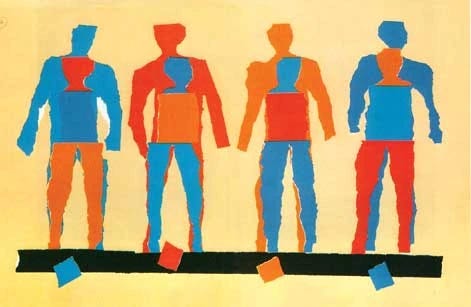
For me, one of the most fascinating parts of the seder has always been the Four Children.
The teaching has its source in four passages in the Book of Exodus, describing four different ways of telling the Exodus story. From these four different ways of telling, the Sages gleaned a sense of four different children, each requiring a different type of instruction: a Wise Child, a Wicked Child, a Simple Child, and a Child Who Knows Not How To Ask.
Besides centuries of siblings and cousins yelling at each other about who is who, the Four Children midrash has yielded countless compelling interpretations about how we’re to understand these four archetypal children.
As Passover approaches, I pulled together four voices to spur your own seder table conversations:
A Unified Vision
According to Rabbi Yehudah Leib Chasman, a noted teacher of musar (Torah ethics), the “Four Children” should not be understood as four distinct personalities, as the traits exemplified by all of them struggle within each of us. One moment we are the wise child, the next moment the wicked child; one instant we are the simple child, the next instant we are unable to ask.
A Family Portrait
The four children are a vignette of the Jewish people. One asks because he wants to hear the answer. A second asks because he does not want to hear the answer. A third asks because he does not understand. The fourth does not ask because he doesn’t understand that he doesn’t understand. Ours has never been a monolithic people.
Yet there is a message of hope in this family portrait. Though they disagree, they sit around the same table, telling the same story. Though they differ, they stay together. They are part of a single family. Even the rebel is there, although part of him does not want to be. This, too, is who we are.
—Commentary on The Four Children, The Jonathan Sacks Haggadah
A Counterintuitive Take from the Haggadah I Grew Up Using:
The wicked son represents the element of sheer perversity, the desire to distance oneself from the whole exercise of reflecting on God’s marvelous deliverances.
The wise son represents the ambition to know all that can legitimately be known, and this need has to be satisfied. The simple son represents the attitude of unquestioning faith, of unsophisticated surrender to the will of God.
Highest of all is the son who does not know how to ask, representing that stage of worship in which the worshipper is so overwhelmed by the divine that even the quest for knowledge becomes an intrusion and God is adored in a silence more eloquent than words.
—from “Sons and Mystics” by Rabbi Louis Jacobs
A Missing Child:
Unfortunately, there is, in our time of confusion and obscurity, another kind of a Jewish child: the child who is conspicuous by his absence from the Seder service; the one who has no interest whatsoever in Torah and G‑d’s commandments... who is not even aware of the Seder, of the Exodus from Egypt and the subsequent revelation at Sinai.
“This presents a grave challenge, which should command our attention long before Passover and the Seder night, for no Jewish child should be forgotten and given up. We must make every effort to save also that “lost” child, and bring the absentee to the Seder table. Determined to do so, and driven by a deep sense of compassion and responsibility, we need have no fear of failure...”
—Menachem Mendel Schneerson, the Lubavitcher Rebbe
In Case You Missed It…
Earlier this week, I offered four questions about the Four Questions…

The Torah Portion Speed Run
This week’s Torah portion, Tzav, Leviticus 6:1 - 8:36, in under a minute!
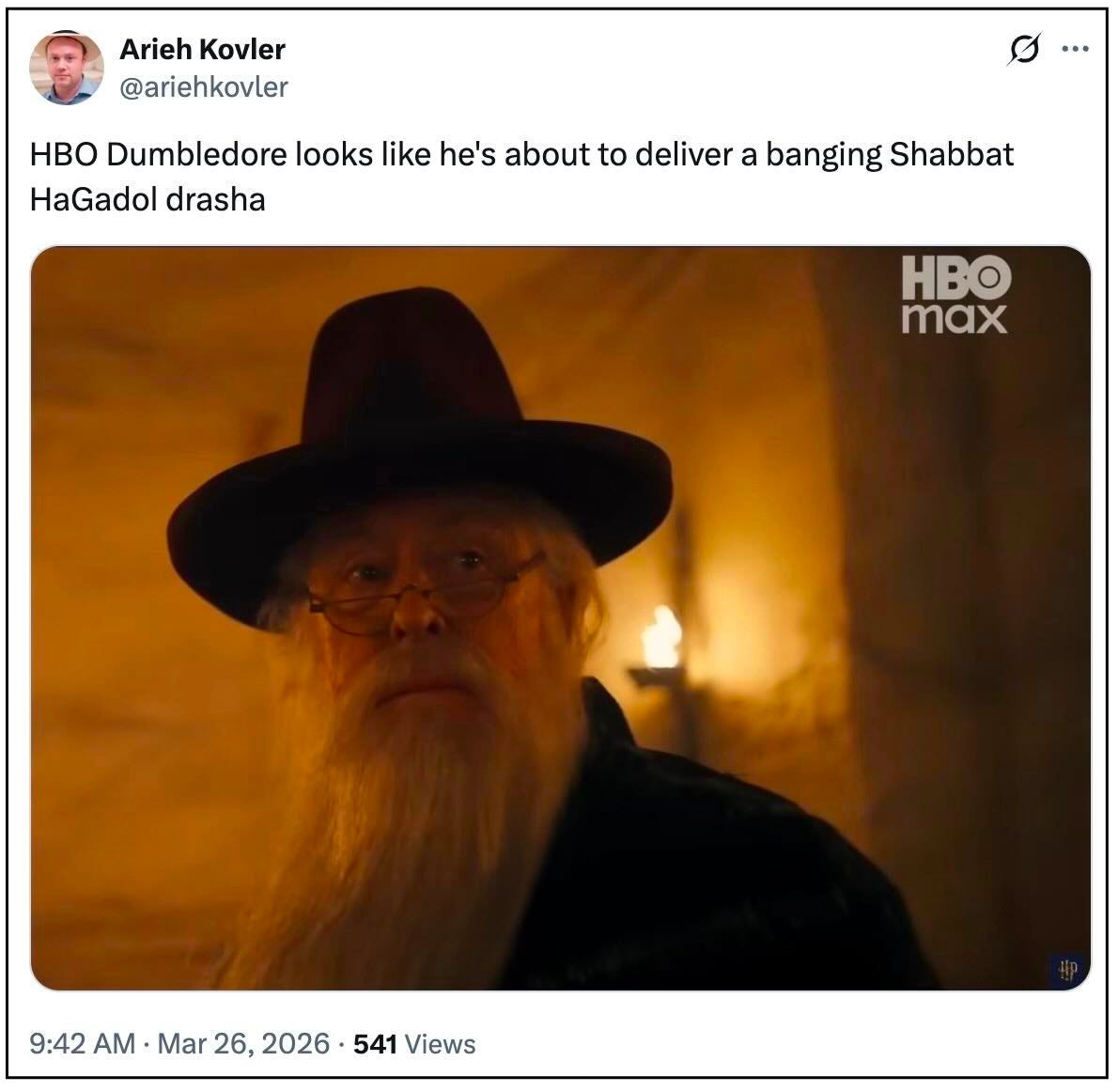
And finally, let’s end with something lighter. Many in the Jewish social media whirl flagged the appearance of Dumbledore in the new HBO Harry Potter series.
My favorite…
Shabbat Shalom, everyone, see you Tuesday!